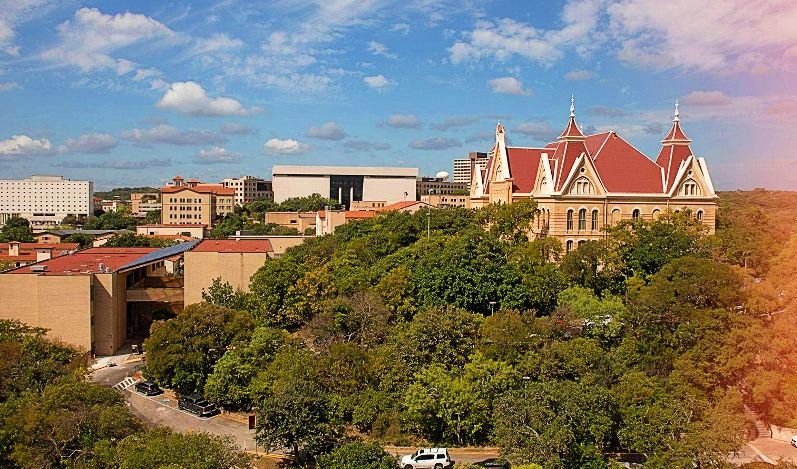
Texas State University sits in a spot most universities don’t get: directly on the San Marcos River, halfway between Austin and San Antonio, on a campus built around a natural spring-fed lake. That location, combined with one of the largest enrollments in the state and a former president among its alumni, makes it a different kind of school than either of the flagship UT or A&M campuses.
Where Texas State Is, and Why That Matters
The main campus is in San Marcos, roughly 30 miles south of Austin and 50 miles north of San Antonio along the I-35 corridor — one of the fastest-growing metro stretches in the country. Texas State also operates a satellite campus in Round Rock focused on health professions and graduate programs, closer to the Austin side of that corridor. The San Marcos River runs directly through campus, feeding Spring Lake, which the university’s Meadows Center for Water and the Environment uses for research and public education on aquifer and river ecology — a genuinely distinctive academic resource compared to inland campuses.
Size and Growth
Texas State is one of the largest public universities in the state by enrollment, and it has been one of the fastest-growing large universities in Texas over the past two decades as the Austin-San Antonio corridor has expanded. That growth has pushed the university to add new residence halls, expand the Round Rock campus, and grow graduate and health-science programs faster than most of its historical liberal-arts-and-education identity would suggest.
Academic Programs It’s Known For
Texas State began in 1899 as a teachers’ college, and education remains a core strength. It has also built a strong reputation in mass communication and journalism, hospitality and tourism management, and respiratory care, and it runs one of the few university aviation programs in the state through its Department of Aviation at the San Marcos Municipal Airport. Its most famous alumnus is Lyndon B. Johnson, the 36th US president, who graduated in 1930 when the school was known as Southwest Texas State Teachers College.
Bobcat Athletics and the Sun Belt
Texas State athletic teams compete as the Bobcats. The football program moved up from the FCS Southland Conference to FBS in 2012 and has competed in the Sun Belt Conference since 2013, playing home games at Bobcat Stadium in San Marcos. The move to FBS and the Sun Belt reflected the university’s broader growth strategy, giving it a higher-visibility athletics profile to match its expanding enrollment.
Campus and Student Life
The San Marcos River isn’t just scenery — tubing the river is a defining student pastime, and the university’s location gives students easy access to the outdoor recreation culture of the Texas Hill Country alongside a college-town downtown. That combination of academics, a hands-on natural resource for environmental science, and proximity to both Austin and San Antonio’s job markets is central to how Texas State markets itself to prospective students.
Frequently Asked Questions
Where is Texas State University located?
In San Marcos, Texas, between Austin and San Antonio, with a second campus in Round Rock.
What is Texas State University known for?
Its education programs, mass communication and hospitality programs, its aviation program, and its river-adjacent campus and Meadows Center water research facility.
What conference do Texas State Bobcats play in?
The Sun Belt Conference, which the football program joined in 2013 after moving up to FBS from the FCS Southland Conference in 2012.
Who is Texas State University’s most famous alumnus?
Lyndon B. Johnson, the 36th president of the United States, who graduated in 1930 when the school was Southwest Texas State Teachers College.
Is Texas State University part of the Texas State University System?
Yes, though the system’s name is a common source of confusion — it also governs several other, unrelated Texas universities such as Sam Houston State and Lamar University.